
But human history started well before there was any written records, first ancient monument or any known civilization. Our primitive ancestors changed their environment, invented their methods of locomotion, found tools, and slowly evolved to meet the conditions of Earth millions of years ago. While these first chapters in human history are incomplete, fossils and archaeology are filling in the amazing story of the evolution of our species.
Each find contributes to the puzzle; from ancient skulls to preserved footprints, from stone tools to signs of Prehistoric settlements. New studies are uncovering that evolution from the primitive ancestors to a human being was not a linear process. Rather, a great diversity of species, of changing environments and of intricate evolutionary relationships. Archaeology and fossil science are therefore changing our conceptions of how and when we came to be and what makes us human.
1. What is the science behind human origins?
Human origins research involves several scientific fields working together to explore human evolution and human ancestors' lifestyles. Archaeology is the study of the objects, structures and remains of past populations while palaeoanthropology is the study of the fossils of humans and their ancient relatives. Other important evidence includes geology, genetics, chemistry and biological anthropology.
Using fossil bones, teeth and stone tools, scientists reconstruct ancient environments and human behaviour; using footprints and animal remains. These results can be compared to the human body, brain and skills in living humans and other primates, allowing researchers to investigate the differences and changes that occurred over millions of years.
Human Evolution is not viewed as a linear evolution to the present day human being, but as a branching process. There were a number of early human species, which lived at times and some at the same time. The diversity is one of the most important findings in the study of our origins.
2. Ancient Fossils: Windows into the Past
Fossils are one of the most rich sources of information on pre-historic life. They are created when bones, teeth or any other biological remains are preserved in nature through geological processes. In appropriate circumstances, mineral water permeates and replaces or fills in portions of the original substance, thus maintaining its form over thousands or millions of years.
Human fossils give information on body size, walking ability, brain development, diet and physical adaptation. A skull can provide clues to the size and shape of the braincase, and the shape of the pelvis, legs and feet can give clues to how an ancient individual walked.
One of the most important uses of teeth is to determine diet and childhood development from the shapes, wear patterns and chemical composition of teeth. The small pieces may be important for science if they are compared with other fossils of the same time period.
Fossils, however, do not always have to provide a complete picture. They must be used in conjunction with geological evidence and archaeological objects and other finds in order to be interpreted and give scientists a more complete picture of ancient human life.
3. Who are the Earliest Members of the Human Family Tree?
The human evolutionary family tree long stretches millions of years in the past. We share an ancestor with chimpanzees and bonobos, although we don't know exactly who or what he or she was. The chimps of today are not the ancestors of humans, but rather humans and other living apes share a common ancestor.
As time passed the physical traits of different populations changed due to adaptation to their environments. Some of our early ancestors evolved a more upright gait, and other characteristics were developed over time on the branches of the family tree.
Hominins have been found in a large number of fossil species in Africa, Asia and Europe. The finds illustrate that human evolution was not simply a predictable replacement of one species by another, but included a variety of old relatives.
The beginning of this evolutionary story is still not clear, as the fossil record is incomplete. However, each new fossil discovered can be used to confirm, refute, or refute the existing theories, as well as reveal new relationships between the populations.
4. Upright Walkers: A Great Evolutionary Transition
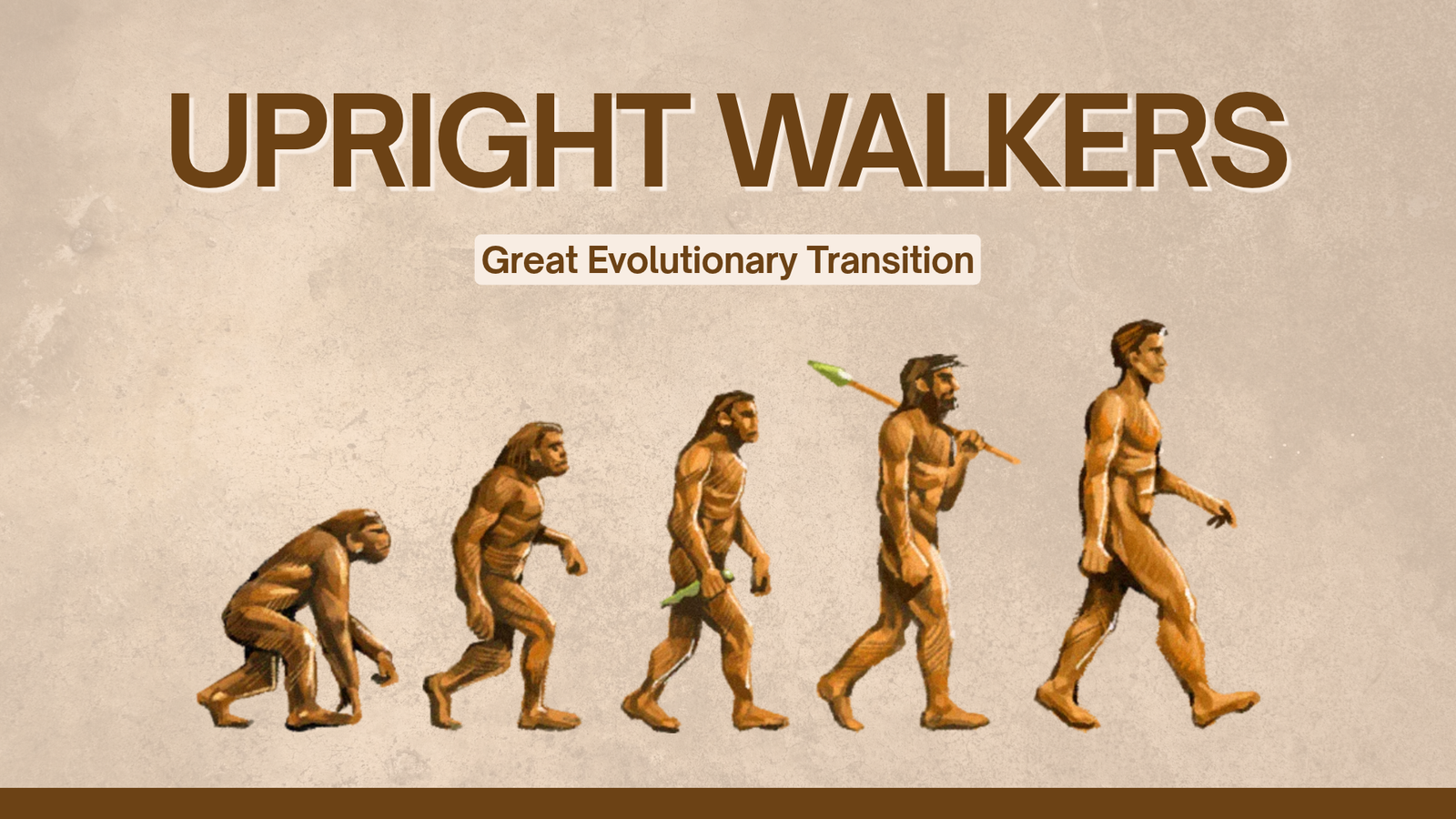
Regularly bipedal locomotion, or the capacity to walk on two feet, was one of the most significant changes that occurred in human evolution. There are indications that as early as 4 million years ago, the ancestors of humankind adapted some form of human walking style.
Walking on two legs had an impact on the pelvis, spine, knees and feet. All of these modifications enabled early hominins to navigate their environments in various ways; however, the benefits of being bipedal may have differed depending on the environment and lifestyle.
Scientists investigate this transition by studying fossilized leg bones, pelvises, foot bones and ancient footprints. The arrangement of these structures can give insights into the distribution of weight and movement of an individual.
The features characteristic of upright walking did not automatically lead to all the features of modern humans. Brain size, tool use, communication and other skills evolved over different time periods. The gradual evolution indicates a series of interacting adaptations to evolution, as opposed to a single defining moment.
5. Lucy and Other Discoveries That Changed Human Evolution
Other fossil finds have had a particular significance due to their impact on science's knowledge about our ancestors. Some of the most famous of these is a partial skeleton of Australopithecus afarensis, known as Lucy, which was found in Ethiopia in 1974. Dating to approximately 3.2 million years ago, Lucy provided valuable evidence about the anatomy and locomotion of an early human relative.
Her skeleton showed features of both traits of an upright gait and traits that were also unique. The finding enabled scientists to better comprehend the way in which early hominins walked before they developed the modern human body design.
Other finds have complicated matters even more. In particular, the Ardipithecus ramidus fossils, including Ardi, have provided some clues to earlier hominins' locomotion. Fossils of H. erectus have also aided scientists in their study of body proportions, locomotion and early expansion outside of Africa.
Each discovery provides only part of the answer. Fossils from various sites and time periods are compared to gain insights into relationships and key changes among past species.
6. Rise of the Genus Homo
The genus Homo comprises the modern humans and a number of extinct species of human beings. There are some fossil records that indicate that the earliest members of this group appeared in Africa over two million years ago, but the categorization and evolutionary relationships of the early species have been the subject of scientific research.
Some members of the genus Homo, as opposed to earlier hominins, had different sets of body characteristics, brain size and technology. Over time, stone tools also grew in variety, with the early people using them for food preparation and for working a variety of materials.
Homo erectus was quite important because individuals or populations of this species or closely related ones ventured outside of Africa into parts of Asia. Archaeological remains and fossils suggest that early humans lived in various environments for many years.
Later human species were endowed with other physical and behavioural traits. Evolution, however, did not proceed in exactly the same way in all cases. The ways in which various populations were adapted to their environment were different, and many of the relationships between the various species of different "age groups" are still under study.
8. The Evolution of The Human Body
There were other types of humans in the ancient world. The distribution of Neanderthals was wide-spread throughout western Asia and Europe, and Denisovans are known mainly from fossil remains and genetic evidence from Asian populations.
Fossils of Neanderthals show a few regions of their distribution where they lived in colder conditions. Archaeological evidence also shows that Neanderthals produced tools, were strategically using resources and complexly behaved. They did not only have to survive in a cold climate and be physically strong.
Denisovans have been another crucial example in the study of genetics to understand ancient populations that are hard to identify based on fossils. Ancient DNA researchers have been able to draw connections between Denisovans, Neanderthals, and human beings.
These groups were not necessarily mutually exclusive. Studies on the DNA confirm that some ancient populations interbred. Today, many people possess minimal DNA from their Neanderthal ancestors, and some also have Denisovan DNA.
This discovery indicates that there has been contact and gene flow between populations of humans.
9. Shell Decorations and Beads
Fossils are a different type of evidence than are stone tools. The bones provide information about anatomy, while tools provide information on practical skills, food processing and technological innovation.
Simple flakes and cores produced by striking one stone against another are early stone tools. These objects could be used for cutting, scraping and processing animal or plant materials. As time went on, tool makers learned to make more precise tools and manufactured a greater range of tools.
Some of the earliest known stone implements are found to be around 3.3 million years old, which is before the earliest generally accepted evidence for the genus Homo. Their presence shows that scientists need to separate out the technology from the human species.
Later archaeological finds show increasingly different traditions of tool manufacture, such as finely crafted hand axes and bone tools. The changes were not similar across all populations, but they illustrate the emergence of a variety of techniques employed by ancient humans.
The materials, methods and locations of tools provide an opportunity for archaeologists to study how knowledge was developed and how technologies transmitted between population groups.
9. Ancient Footprints, Art and Evidence of Human Behaviour
Not all archaeological discoveries consist of bones or tools. The footprints, engravings, paintings and other marks of activity give clues to aspects of human activity that are not explained by the bones.
Fossils of footprints provide clues to how an animal moved, as well as body size and the possibility of more than one animal in the same place. If multiple tracks are seen, researchers can examine the tracks to see if they were formed at the same time, and what they can tell about movement over an ancient landscape.
Art and symbolic objects are another lens through which to examine human cognitive and cultural evolution. Paintings, engraved surfaces, objects and objects that have been carefully altered can provide evidence of communication, social identity and symbolic expression in prehistoric paintings.
Care must be taken in interpreting these discoveries. A footprint doesn't necessarily tell the whole story of the purpose of a journey, and the significance of an ancient item can also be unclear. Overall, these are traces that, along with other evidence, can be used to investigate human interaction and understanding of the environment during early human history.
10. Climate Change and Human Evolution
There was a time of environmental change for the evolution of humans. Changes in temperature, precipitation, plants and water led to changes in the environments where ancient populations lived.
The fossil record and geology shows that early humans lived in woodland, grassland and environments that evolved. These conditions were met by various species in various ways, including changing their ways of moving, eating, and/or physically adapting.
Climate change might have affected the availability of food and water, migration, and where and when populations were found. But it is not the only factor that explains evolutionary developments. But biological variation, competition, technology and random events also played a role in human populations' history.
Pollen, sediments, animal remains and other geological clues are used to recreate the environments of the past. These records can be used to relate shifts in human behavior to contexts in which they are found.
It is especially important today to understand this relationship as it demonstrates the way in which human populations have responded to changes in their environment throughout their evolutionary history.
11. How the Worldview of the Ancients Has Changed Over Time
Advances in science are yielding new insights from old bones. Improvements in imaging, DNA testing, chemical testing and dating techniques have revolutionized the study of human origins.
Three dimensional scanning enables scientists to study and get a detailed look at the shape of fossils without having to handle them repeatedly, especially fragile specimens. The digital models can be compared to other fossils and shared with other researchers from all over the world.
Some fossil materials preserve their protein content for scientists to examine and determine similarities in their biology, while ancient DNA analysis can be used to determine genetic relationships between populations. The teeth and bones can be analyzed chemically for clues to diet and movement, and the environment in which people lived.
Other dating techniques, such as radiometric dating, can be used to determine how long ago certain remains or archaeological layers were deposited. However, scientists will often use more than one technique since each method has its own limitations and uses.
These strides don't remove the uncertainty. Rather, they enable investigators to conduct more careful hypothesis testing and determine if further evidence exists to support or refute the hypothesis. New discoveries are also becoming available for fossils that were already found, but have new information that could not be obtained at the time of discovery.
12. What New Developments In Technology May Bring: Human Remnants in a future past
The fossil record of humans is not complete, and many questions remain to be answered regarding the origins of humankind. Evidence of possible relationships between early hominins, the evolution of key physical characteristics and the migration of ancient populations over continents is still being sought.
Fossils which may be found in future may represent a poorly represented time. Tools, footprints or environmental information may also be found at new archaeological sites and alter knowledge of specific phases of human evolution.
Use of technology is likely to be significant in this work. New techniques in imaging, more sensitive molecular techniques and advanced dating methods might enable scientists to examine delicate remains and find patterns that were previously hard to see.
Archaeological sites and fossil collections also need to be safeguarded from damage, illegal excavations and damage from environmental factors. Removing a fossil or artefact without documentation can result in valuable information about its site and context being lost forever.
The preservation of existing remains, as well as the discovery of new remains, is therefore crucial to human origins research, which must rely on the preservation of evidence as well as the accessibility of scientific findings to the researchers and public.
Final Thoughts: Where do we come from?
The study of ancient fossils, and archaeological excavations, have revolutionized our knowledge of the origins of man. Evidence recovered from Africa, Asia and Europe shows that evolution has been long and complex and is a consequence of environmental change, biological adaptation, technological innovation and interactions among various human populations.
Fossils tell us about our ancient ancestors bodies, and tools, footprints and archaeological remains give us clues as to how they lived. Genetics and the use of modern analytical methods bring additional layers to this evidence, and enable scientists to explore relationships that are not necessarily detectable by anatomy.
Perhaps the most significant lesson to be learnt is that it was not always a linear path of evolutionary progression to a fixed end state. Our species came from a wide variety of evolutionary trees, and much of our defining species characteristics evolved slowly over millions of years.
Each new find can overturn an old explanation or uncover a new facet of the history. Careful examination of these clues allows scientists to address basic questions of humanity: how did we get this way, where and how do we belong in relation to the ancient world.
1. What is the science behind human origins?
Human origins research involves several scientific fields working together to explore human evolution and human ancestors' lifestyles. Archaeology is the study of the objects, structures and remains of past populations while palaeoanthropology is the study of the fossils of humans and their ancient relatives. Other important evidence includes geology, genetics, chemistry and biological anthropology.
Using fossil bones, teeth and stone tools, scientists reconstruct ancient environments and human behaviour; using footprints and animal remains. These results can be compared to the human body, brain and skills in living humans and other primates, allowing researchers to investigate the differences and changes that occurred over millions of years.
Human Evolution is not viewed as a linear evolution to the present day human being, but as a branching process. There were a number of early human species, which lived at times and some at the same time. The diversity is one of the most important findings in the study of our origins.